
Short responses (high school form)
Four short answers, none longer than 250 words. They replace the 650-word essay.
The high school form asks four short responses. You write them in the form itself. There is no essay to upload and no separate document to send.
Nothing rewards length here. If you can answer a question in half the words, answer it in half the words.
| Response | Word limit |
|---|---|
| 1. What this award would change | 250 |
| 2. What you have done with what you had | 250 |
| 3. Who your education is for | 250 |
| 4. What you are trying to figure out | 150 |
The four questions
1. What this award would change
250 words or fewer.
If you receive this $5,000 scholarship, what will you be able to do that you cannot do now? If you do not receive it, what will you most likely do instead?
Answer it plainly. Name the cost, the term, the hours of work, or the thing you would drop. This is the answer that carries the most weight of the four.
2. What you have done with what you had
250 words or fewer.
Tell us what you had to work with: the time, the money, the tools, the people. Then tell us about one thing you built, learned, fixed, or kept going despite a limit.
A small thing done under a real constraint tells us more than a large thing done with help.
3. Who your education is for
250 words or fewer.
Tingyu Lu paid attention to the people around him. Tell us about one problem you have noticed in your family, school, or community that you want your education to help with.
One problem is enough. It does not have to be large, and it does not have to be solved.
4. What you are trying to figure out
150 words or fewer.
This is the short one. We are not asking for a settled plan, and an honest open question reads better than a rehearsed answer.
Two things you may add
Both are optional. Leaving either one blank does not count against you.
Additional context
150 words or fewer. If something about your situation does not fit the four questions, put it here.
Optional Video Profile
Applicants who would like to add their voice to their application may submit an optional video profile. This is not required, and choosing not to submit a video will not disadvantage your application.
It is a brief, two-minute video introduction. It is there to give you one more place to say something the rest of the application did not fully cover: context, a personal reflection, or anything else you would like the Selection Committee to consider.
Your video does not need to be rehearsed, polished or professionally edited. Record it however you like. A phone camera is fine, and we do not read production quality.
How to submit it
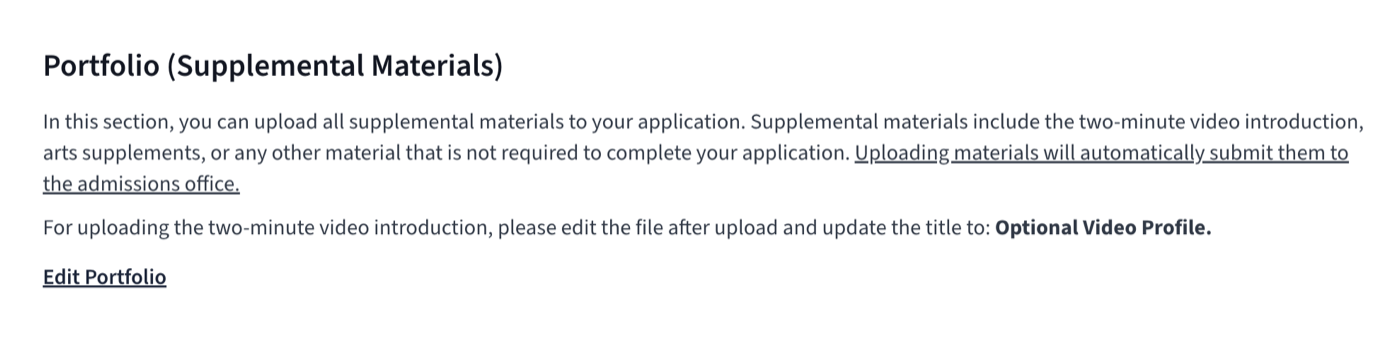
You submit the video after you have sent in your application, not with it. It is uploaded in the Goal Get It! applicant portal, on your application status page, which becomes available once you have submitted.
- Open your application status page and find the Portfolio (Supplemental Materials) section.
- Upload either a video file or a link to your video. Uploading sends it to us straight away, so upload it when you are ready for us to see it.
- Edit the file after it uploads and change its title to Optional Video Profile. That exact title is how we identify it, so please do not shorten or reword it.
How we read these
We read for three things, in this order.
- Whether you are ready to finish what you start. That comes mostly from your transcript and your recommendation, not from these answers. There is no minimum grade average, and we are not ranking you against the other applicants.
- What the money would change. Question 1 carries more weight than anything else you write.
- What you did with what you had, and who your education is for. Questions 2 and 3.
We do not score test scores, award lists, the number of activities you name, the school you attend, or how polished the writing is. A first-generation applicant writing in a second language is not at a disadvantage here.
How we read an application sets out the whole review, not only these four answers.
Your own words
We understand that seeking feedback, whether from a friend, parent/guardian, teacher, mentor, generative AI, or another resource, can be part of drafting and revising your writing. You may use feedback to improve clarity and strengthen your ideas. However, all responses submitted in this application must ultimately be your own, original work, written in your own voice.
Where to write them
The responses live in the high school application on our portal. You can save a draft and come back to it.